

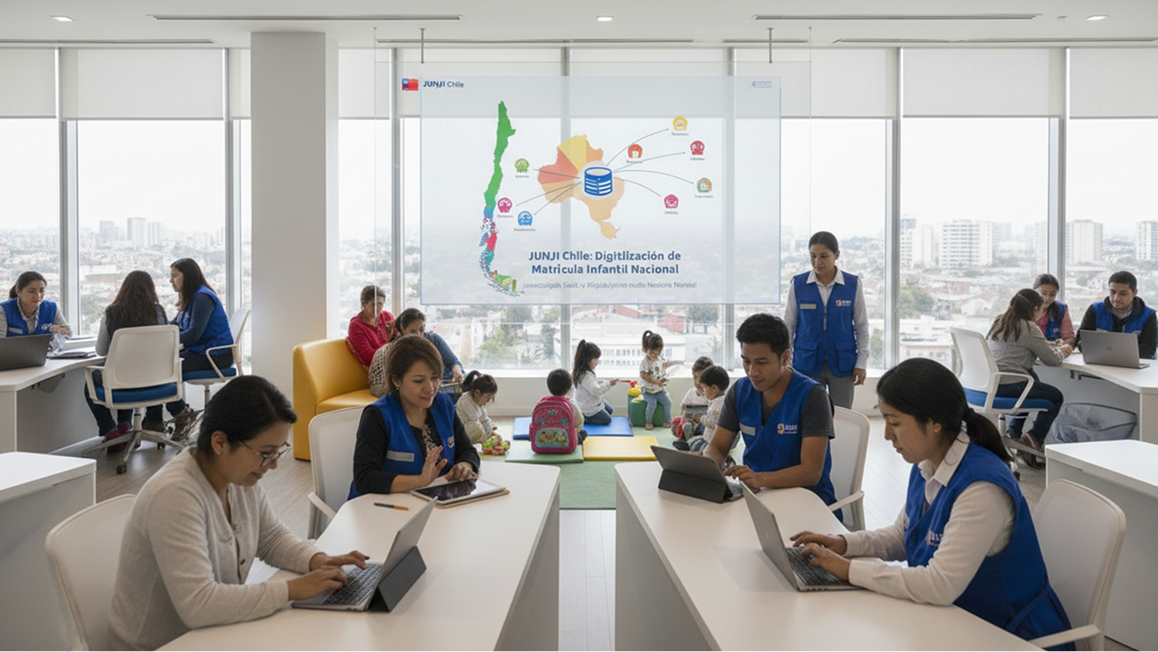
Digitizing Early Childhood Enrollment for Chile’s JUNJI Network
Summary
Chile’s national early childhood education organization, Junta Nacional de Jardines Infantiles (JUNJI), sought to upgrade and further digitize their enrollment. Legacy processes were siloed and often differed across providers. This lack of coordination—both at a process and data management level—meant that families had to struggle to gain access to child care, while providers and the government were unable to effectively predict demand, fill vacancies, and improve overall system quality.
In 2023, JUNJI partnered with Tether Education (TetherEd) to implement a centralized platform that leverages research-backed tools and a heavily-integrated data layer. This means families get easy and often instant access to care through a single enrollment process. At a system level, it also eases administrative burden for providers and unlocks countless improvement opportunities for the government.
Background
Since 1970, JUNJI has served children and families with direct service and through funding for third-party early childhood education providers. JUNJI covers nearly 200,000 child care spots across the country, with a focus on providing access especially to low-income families.
JUNJI’s previous enrollment allocation process prioritized applicants by socioeconomic status, but it did not sufficiently integrate vacancy and waitlist processes across the 3,000 providers in its network. This prior process resulted in several pain points for stakeholders:
- Families had to endure a fragmented search process, interacting with multiple providers within the JUNJI network to find an available spot. Low-income families suffer especially from costly and confusing search processes, limiting their child care access.
- Provider administrators spent hours coordinating with prospective families and managing waitlists; despite high effort, many seats were still left unfilled.
- At the government level, this data and process fragmentation made it hard to understand the evolving needs of the child care system, efficiently enforce quality and accountability standards, and ultimately fulfill JUNJI’s mandate of providing child care access to its constituents
To remedy these issues, JUNJI issued a pair of RFPs in 2023 to redesign both the allocation algorithm and the application and enrollment system.
Solution
Since the mid-2010s, TetherEd staff have advised the Chilean government regarding its education policy. Building upon that trusted advisor role, TetherEd redesigned and implemented a new K-12 admissions system in 2022, coordinating applications and facilitating waitlists year-round for the whole country. The same experiences and principles extend to child care, and as a result, TetherEd was awarded both JUNJI contracts.
TetherEd has ample experience in algorithm development and deployment. Leveraging methods developed in the field of market design, TetherEd constructed the algorithm to comply with multiple prioritization criteria, including sibling and socioeconomic indicators.
The platform that facilitates the algorithm was integrated with existing data systems, including enrollment and waitlist datasets. To take advantage of this synchronized data platform, TetherEd implemented research-backed, AI-enabled family support tools to advise applicants on the availability and quality of child care options. For example, families are able to simulate their application odds based on live system-wide enrollment data and their own personal characteristics, allowing them to adjust their application before submission. The platform also recommends alternate available options to expand families’ option pool and increase their chances of successful enrollment. As families were guided through a single process with the help of TetherEd’s platform, providers were relieved of administrative burdens and could instead devote that energy to serving their families and children.
The centralized platform makes it easier for families to search for and apply to care while accelerating enrollment. Rather than waiting for periodic matching cycles, families can often secure a seat immediately upon applying. TetherEd's predictive analytics tool enables administrators to forecast application volume and demand patterns, allowing them to instantly approve qualified applicants based on their priority criteria—such as neighborhood, socioeconomic level, or voucher status. The integrated waitlist then notifies other providers when a family has accepted a seat elsewhere, enabling them to efficiently move down their own waitlists. Chile is one of the world’s first systems with this capability.
TetherEd’s new platform has benefits for the government as well. Now with synchronous access to enrollment data and a clear, uniform connection to providers, further efforts to investigate quality or explore additional policies will face low marginal costs. Other technological innovations can more easily stack upon this new system as well. Indeed, building a robust enrollment data system with full coverage is key to unlocking the benefits of digitalization for all. As TetherEd works with the government to maintain and develop this ecosystem, data-rich impact and research reports are expected to further promote iterative improvement. Already, families and child care providers are sharing how the improved system has eased access and streamlined enrollment processes.
TetherEd is dedicated to partnering with education agencies, schools, and communities to advance transparent, equitable, and effective enrollment processes. To learn more about how research and practical tools can support your school system’s goals, please get in touch.


